A Deep Dive into Blackhole Attacks in Network Security
In the intricate and often invisible world of network communications, data packets diligently traverse complex routes to reach their destinations. However, not all entities within these networks are benign. Imagine sending a critical message, only for it to vanish without a trace, silently swallowed by a malicious void. This scenario is the hallmark of a Blackhole attack, a potent and insidious threat capable of crippling network operations. This type of attack undermines the very foundation of reliable data delivery, making it a significant concern for network architects, security professionals, and users alike.

The objective of this post is to provide a comprehensive exploration of Blackhole attacks, dissecting their nature, motivations, typical environments, historical context, and most crucially, the technical mechanisms behind their execution and defense. We aim to equip you with a deep, multi-faceted understanding of this silent saboteur.
In this post, we will delve into the following aspects of Blackhole attacks:
Table of Contents
- WHAT is a Blackhole Attack?
1.1. Defining the Deception: Core Concepts
1.2. The Anatomy of Traffic Disappearance
1.3. Distinguishing from Similar Attacks (e.g., Greyhole, Sinkhole) - WHY Do Blackhole Attacks Occur and What is Their Impact?
2.1. Attacker Motivations: The Drive to Disrupt and Deny
2.2. The Ripple Effect: Consequences of a Successful Attack
2.3. Advantages for the Adversary
2.4. The Significance in Network Security Landscape - WHO Are the Actors in a Blackhole Attack Scenario?
3.1. The Perpetrators: Characterizing Malicious Nodes
3.2. The Targets: Identifying Vulnerable Entities and Systems
3.3. The Defenders: Roles and Responsibilities in Mitigation - WHERE Are Blackhole Attacks Most Prevalent?
4.1. Wireless Ad-Hoc Networks (MANETs, VANETs)
4.2. Wireless Sensor Networks (WSNs) and IoT Ecosystems
4.3. Routing Protocols and Infrastructure Vulnerabilities
4.4. Cloud Environments and Virtualized Networks - WHEN Do Blackhole Attacks Manifest?
5.1. Historical Context and Evolution
5.2. Common Scenarios and Triggers
5.3. The Attack Timeline: From Reconnaissance to Impact
5.4. Future Trends and Evolving Threats - HOW Do Blackhole Attacks Work and How Can They Be Countered?
6.1. The Mechanics of Deception: Attack Vectors and Techniques
6.1.1. Exploiting Routing Protocols (e.g., AODV, DSR in MANETs)
6.1.2. False Route Advertisement
6.1.3. The Cooperative Blackhole Attack (Multiple Attackers)
6.2. Detecting the Invisible: Identification Strategies
6.2.1. Traffic Monitoring and Anomaly Detection
6.2.2. Proactive vs. Reactive Detection Mechanisms
6.2.3. Sequence Number Analysis (e.g., in AODV)
6.2.4. Cryptographic Approaches and Trust-Based Systems
6.3. Building Defenses: Prevention and Mitigation
6.3.1. Secure Routing Protocols (e.g., SAODV, ARAN)
6.3.2. Intrusion Detection and Prevention Systems (IDPS)
6.3.3. Redundancy and Multipath Routing
6.3.4. Ingress and Egress Filtering
6.3.5. Honeypots and Deception Technology
1. WHAT is a Blackhole Attack?
Understanding the fundamental nature of a Blackhole attack is the first step toward appreciating its implications and formulating defenses. It's an attack that hinges on deception and the quiet betrayal of trust within network routing mechanisms.
1.1. Defining the Deception: Core Concepts
A Blackhole attack, in the context of network security, is a type of denial-of-service (DoS) attack where a malicious node - the "blackhole" - falsely advertises itself as having the most optimal or shortest path to a destination node or network segment. This deceptive advertisement lures legitimate traffic from source nodes, which, trusting the routing information, redirect their data packets through the malicious node. Once the traffic reaches the blackhole, instead of forwarding it to the intended recipient as a legitimate router would, the blackhole node silently discards or "drops" all received packets. This effectively creates a void where data disappears without any notification to the sender or the intended recipient, leading to a complete breakdown in communication for the affected routes. The core concept revolves around the malicious node exploiting the route discovery process inherent in many network protocols.
1.2. The Anatomy of Traffic Disappearance
The "disappearance" of traffic is the defining characteristic of a blackhole. Unlike some attacks that might modify or redirect data for eavesdropping, a pure blackhole attack is primarily about causing unavailability. The attacker's node essentially becomes a data sink. It receives packets as if it's a legitimate intermediary hop, but internally, its logic is programmed to simply discard them. This lack of forwarding and the absence of error messages back to the source (like an "ICMP Destination Unreachable" message that a congested or misconfigured legitimate router might send) make blackhole attacks particularly insidious. Senders might continue to resend data, assuming transient network issues, thereby wasting resources and prolonging the disruption until the attack is detected and mitigated, or the routing tables are updated to bypass the malicious node.
1.3. Distinguishing from Similar Attacks (e.g., Greyhole, Sinkhole)
While "blackhole" is a common term, it's important to distinguish it from closely related attacks to understand the nuances.
A Greyhole attack is a variation of the blackhole attack. In a greyhole attack, the malicious node behaves selectively. It might drop packets destined for certain specific addresses, or it might drop packets intermittently (e.g., dropping every third packet, or packets at random intervals). Sometimes, a greyhole node might initially behave like a normal node to gain trust and establish itself on a route, only to begin dropping packets later. This selective or intermittent dropping makes greyhole attacks harder to detect than pure blackhole attacks, as some traffic might still successfully reach its destination.
A Sinkhole attack has broader implications and motivations. While it also involves a malicious node attracting traffic, the purpose might not solely be to drop it. A sinkhole might be established to attract all traffic from a specific area of a network (e.g., in a Wireless Sensor Network, a malicious node might appear very attractive to all nearby sensors). Once traffic is drawn to the sinkhole, the attacker might analyze it for sensitive information (eavesdropping), modify it (integrity attack), selectively forward some parts while dropping others (making it behave like a greyhole or blackhole), or launch other attacks. In some contexts, network administrators might intentionally create a "benign sinkhole" (often called a "null route" or "blackhole route" in ISP terminology, confusingly) to divert and drop unwanted traffic, such as traffic from a DDoS attack or known malicious IP addresses, away from critical infrastructure. However, in the context of attacks, a malicious sinkhole is a serious threat.
The primary distinction for a classic blackhole attack is the consistent dropping of all traffic that it successfully attracts through deceptive routing.
Here's a brief comparative table for Blackhole, Greyhole, and Sinkhole attacks:
| Feature | Blackhole Attack | Greyhole Attack | Sinkhole Attack |
| Packet Handling | Drops all attracted packets | Selectively drops attracted packets | Attracts traffic; can then drop, selectively forward, analyze, or modify packets |
| Selectivity | Generally non-selective for the route | Highly selective (intermittent, specific types) | Can be broad (area) or specific (service/destination) |
| Primary Goal | Denial of Service (DoS) | Subtle DoS, targeted disruption, evasion | DoS, eavesdropping, traffic analysis, further attacks, network mapping |
| Detectability | Moderate | Harder (due to intermittent/selective behavior) | Varies (depends on subsequent actions after attracting traffic) |
2. WHY Do Blackhole Attacks Occur and What is Their Impact?
The motivations behind launching blackhole attacks are varied, but they generally revolve around disrupting network services and causing denial of service. The impact can range from minor annoyance to catastrophic failure, depending on the target and the network's criticality.
2.1. Attacker Motivations: The Drive to Disrupt and Deny
The foremost motivation for an attacker deploying a blackhole is to cause a Denial of Service. By ensuring that packets do not reach their intended destination, the attacker effectively severs communication links. This could be aimed at a specific user, a critical server (like a web server or a database server), or even an entire segment of a network. The attacker might be driven by malice, a desire to harm a competitor, activism (hacktivism), or as a precursor to a larger, more complex attack strategy. For instance, by isolating a particular node, an attacker might then attempt to compromise it without interference from security monitoring systems that it can no longer reach. In some cases, particularly in cyber warfare or corporate espionage, the goal might be to disrupt an organization's operations, causing financial loss or reputational damage.
2.2. The Ripple Effect: Consequences of a Successful Attack
The consequences of a blackhole attack extend beyond simple packet loss. The immediate result is a breakdown in communication. Users may find themselves unable to access services, applications might fail, and critical data updates might be lost. This can lead to data loss or inconsistency, especially if acknowledgments are also being blackholed, preventing senders from knowing that their transmissions failed.
Further, legitimate nodes might waste significant resources attempting to retransmit lost packets, consuming bandwidth, processing power, and, in the case of battery-operated devices like those in MANETs or WSNs, precious energy reserves. This can lead to premature node failure and further network degradation.
In larger networks, a strategically placed blackhole can cause network partitioning, where different parts of the network become isolated from each other, unable to communicate. This can have severe consequences for distributed systems and collaborative applications. The overall Quality of Service (QoS) plummets, user trust erodes, and depending on the application (e.g., emergency services, financial transactions), the impact can be severe and far-reaching. For example, in a vehicular ad-hoc network (VANET), a blackhole attack could prevent safety-critical messages from being exchanged between vehicles, potentially leading to accidents.
2.3. Advantages for the Adversary
From an attacker's perspective, blackhole attacks can be appealing due to their relative simplicity to implement in certain network environments, particularly those using routing protocols with known vulnerabilities and lacking strong authentication mechanisms. Compared to more complex attacks like man-in-the-middle attacks that require intercepting, potentially modifying, and then forwarding traffic, a blackhole simply needs to attract and discard. This lower complexity can mean less sophisticated attackers can still cause significant disruption. Furthermore, the "silent" nature of packet dropping can sometimes delay detection, giving the attacker a longer window to inflict damage before countermeasures are deployed.
2.4. The Significance in Network Security Landscape
Blackhole attacks are a fundamental threat vector, especially in decentralized, dynamic, and resource-constrained networks. Their study highlights critical vulnerabilities in routing protocols and underscores the need for robust security mechanisms like route authentication, intrusion detection, and resilient network design. They serve as a constant reminder that the trust assumptions made in many networking protocols can be exploited. The significance of blackhole attacks is amplified in emerging paradigms like the Internet of Things (IoT), where billions of often insecure devices form vast networks, creating an expanded attack surface. Addressing the threat of blackhole attacks is therefore integral to ensuring the reliability, availability, and trustworthiness of modern communication networks.
3. WHO Are the Actors in a Blackhole Attack Scenario?
A blackhole attack involves distinct categories of actors, each playing a specific role in the unfolding and mitigation of the threat. Understanding these roles is essential for developing comprehensive security strategies.
3.1. The Perpetrators: Characterizing Malicious Nodes
The primary perpetrator is the malicious node or attacker. This entity is responsible for initiating the blackhole attack. A malicious node can take several forms:
It could be an external attacker who introduces a rogue device into the network with the express purpose of executing the attack. This often requires physical proximity or access in wireless networks, or exploiting an unsecured network entry point.
Alternatively, it could be an internal attacker, where a legitimate node within the network is compromised and turned malicious. This is often a more dangerous scenario as the compromised node already possesses a degree of trust and network credentials. An insider with malicious intent could also deliberately configure a device they control to act as a blackhole.
The technical capability of the malicious node doesn't necessarily have to be superior to other nodes in the network; it primarily needs to be able to manipulate routing protocol messages effectively or possess enough resources to overpower legitimate route advertisements in certain scenarios (e.g., by consistently claiming better metrics). Their defining characteristic is their intent to disrupt traffic flow by attracting and then dropping packets.
3.2. The Targets: Identifying Vulnerable Entities and Systems
The targets of a blackhole attack are diverse and depend on the attacker's objectives. Essentially, any entity that relies on the network for communication can be a victim. Specific targets can include:
- Individual end-user devices: A specific user's computer or mobile device could be targeted to prevent them from accessing network resources.
- Specific servers or services: An attacker might target a critical web server, an authentication server, or a database to disrupt a particular service.
- Entire network segments or subnets: By targeting a router or gateway, an attacker can blackhole traffic destined for an entire portion of the network.
- Data flows between specific applications: Communications for a particular application (e.g., financial transactions, industrial control commands) could be the focus.
- The network infrastructure itself: In MANETs or WSNs, the attack might aim to disrupt the overall network fabric and its routing capabilities, rather than a single specific endpoint.
The vulnerability of these entities often stems from their reliance on insecure routing protocols, lack of sufficient traffic monitoring, or the inherent openness of the network environment they operate in.
3.3. The Defenders: Roles and Responsibilities in Mitigation
The defenders are those individuals, systems, and protocols designed to prevent, detect, and respond to blackhole attacks. Key defenders include:
- Network Administrators and Security Operations (SecOps) Teams: These professionals are responsible for configuring network devices securely, monitoring network traffic for anomalies, investigating security alerts, and implementing mitigation strategies. They are often the first line of human defense.
- Protocol Designers and Standardization Bodies: Researchers and engineers who design network protocols play a crucial role by incorporating security features directly into the protocols (e.g., secure routing protocols that use cryptographic authentication).
- Developers of Security Solutions: Companies and open-source communities that create Intrusion Detection Systems (IDS), Intrusion Prevention Systems (IPS), firewalls, and other security software provide the tools that administrators use to protect their networks.
- Security Researchers: Academics and industry researchers continuously study attack mechanisms like blackholes, develop new detection algorithms (including machine learning-based approaches), and propose novel defense architectures.
- End-users (to a lesser extent): While not primarily responsible for network-level defense, security-aware users can contribute by reporting suspicious network behavior and maintaining the security hygiene of their own devices to prevent them from being compromised and used in attacks.
The collective effort of these defenders is aimed at making networks more resilient to blackhole attacks and other threats, ensuring that data can traverse the network reliably and securely.
4. WHERE Are Blackhole Attacks Most Prevalent?
Blackhole attacks are not uniformly prevalent across all network types. Certain network architectures and environments are inherently more susceptible due to their characteristics, such as dynamic topologies, lack of centralized administration, and the nature of their routing protocols.
4.1. Wireless Ad-Hoc Networks (MANETs, VANETs)
Mobile Ad-hoc Networks (MANETs) are prime candidates for blackhole attacks. MANETs are self-organizing, infrastructure-less networks where nodes are mobile and communicate wirelessly. Routing paths change frequently, and nodes rely on cooperation to forward packets. Standard MANET routing protocols like Ad hoc On-Demand Distance Vector (AODV) or Dynamic Source Routing (DSR), in their basic forms, often lack robust security mechanisms. An attacker can easily inject a malicious node that falsely advertises fresh and short routes, tricking other nodes into routing traffic through it. The dynamic nature and lack of a central trusted authority make it challenging to quickly identify and isolate such malicious nodes.
Vehicular Ad-hoc Networks (VANETs), a specialized form of MANETs for communication between vehicles and roadside infrastructure, also share these vulnerabilities. Given the safety-critical nature of many VANET applications (e.g., collision avoidance, emergency alerts), a blackhole attack in a VANET can have severe real-world consequences.
4.2. Wireless Sensor Networks (WSNs) and IoT Ecosystems
Wireless Sensor Networks (WSNs) consist of numerous, often resource-constrained, sensor nodes deployed to monitor physical or environmental conditions. These nodes typically have limited processing power, memory, and energy. Routing in WSNs is often hierarchical or data-centric. Blackhole attacks in WSNs can be devastating, as a malicious node can attract data from a large number of sensors and discard it, rendering the monitoring application useless or preventing critical data from reaching the base station. The resource constraints of sensor nodes make implementing complex cryptographic security mechanisms challenging.
The IoT ecosystem, with its vast proliferation of interconnected devices, many of which are also resource-constrained and may use lightweight communication protocols, presents an enormous attack surface. Blackhole attacks can disrupt smart homes, industrial control systems, healthcare monitoring, and other IoT applications by targeting vulnerable devices or the underlying network infrastructure. The heterogeneity of IoT devices and protocols further complicates security efforts.
4.3. Routing Protocols and Infrastructure Vulnerabilities
Beyond ad-hoc networks, any network that utilizes routing protocols with exploitable weaknesses can be susceptible. While core Internet routing (using BGP) has its own set of security concerns (like BGP hijacking, which can lead to traffic blackholing on a massive scale), internal routing protocols within autonomous systems can also be targeted if not properly secured. If a router within an enterprise network is compromised or a malicious device is introduced, it could potentially launch a blackhole attack against internal traffic by manipulating protocols like OSPF or RIP, assuming inadequate authentication or security measures are in place. The key factor is the ability of an attacker to inject false routing information that is accepted by other routers.
4.4. Cloud Environments and Virtualized Networks
Cloud computing environments and virtualized networks, while offering immense flexibility and scalability, also introduce new complexities and potential vulnerabilities. Within a virtualized network, if the mechanisms controlling virtual routing and switching can be compromised, an attacker might be able to create a blackhole effect for traffic between virtual machines or tenants. Misconfigurations in software-defined networking (SDN) controllers or compromised controller interfaces could also theoretically be exploited to redirect and drop traffic. While cloud providers invest heavily in security, the internal East-West traffic within a data center or a virtual private cloud could be targeted if an attacker gains a foothold.
In essence, blackhole attacks thrive in environments where trust is implicit, verification is weak, and the dynamic or distributed nature of the network makes comprehensive monitoring and rapid response difficult.
5. WHEN Do Blackhole Attacks Manifest?
Understanding the temporal and situational contexts in which blackhole attacks occur is crucial for anticipating and mitigating them. These attacks are not random events but are often tied to specific network states, protocol vulnerabilities, and attacker intent.
5.1. Historical Context and Evolution
The concept of blackhole attacks became particularly prominent with the rise of MANETs in the late 1990s and early 2000s. The initial designs of MANET routing protocols prioritized functionality and efficiency in dynamic environments, sometimes with security as a secondary consideration. As these networks found more practical applications, their vulnerabilities, including susceptibility to blackhole attacks, became active areas of research. Early attacks were often simple, exploiting the basic mechanics of protocols like AODV. Over time, attackers' techniques have evolved, leading to more sophisticated variations, such as cooperative blackhole attacks where multiple malicious nodes collude, making detection and mitigation more challenging. The proliferation of WSNs and later IoT devices, often built with similar resource constraints and sometimes lax security, provided new fertile ground for these types of attacks.
5.2. Common Scenarios and Triggers
Blackhole attacks are most commonly triggered and successfully executed during specific network phases and under certain conditions.
One of the most critical phases is route discovery. In on-demand routing protocols (like AODV), when a source node needs to send a packet to a destination for which it has no current route, it initiates a route discovery process by broadcasting a Route Request (RREQ) message. A blackhole attacker listening for RREQs can immediately send a fraudulent Route Reply (RREP) message, claiming an excellent (often the shortest and freshest) path to the destination. If this malicious RREP reaches the source node before legitimate RREPs from other nodes or the actual destination, the source node will establish the route through the attacker.
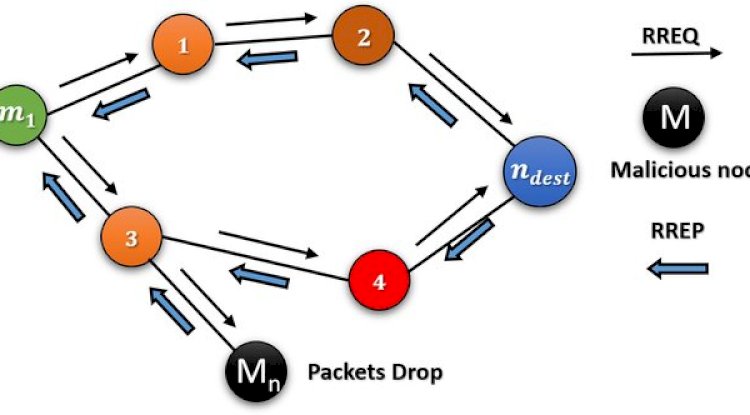
(Source: DOI: 10.1109/ACCESS.2020.3045004)
Other trigger conditions include:
- Network topology changes: In dynamic networks, when existing routes break due to node mobility or failure, new route discovery processes are initiated, providing fresh opportunities for attackers.
- Introduction of a new, unvetted node: If a new node joins the network and is not properly authenticated or monitored, it could be a malicious entity ready to launch an attack.
- Exploitation of known vulnerabilities: If a network is running protocols with unpatched or known vulnerabilities that facilitate route manipulation, an attacker can exploit these at any time.
- Lack of continuous monitoring: In networks without robust intrusion detection or traffic analysis, an attack can be launched and persist for extended periods without being noticed.
5.3. The Attack Timeline: From Reconnaissance to Impact
A blackhole attack, while sometimes opportunistic, can also follow a general timeline:
- Reconnaissance (Optional): An attacker might first passively monitor network traffic to understand routing patterns, identify high-value targets, or discover which routing protocols are in use and their potential weaknesses.
- Insertion/Compromise: The attacker introduces a malicious node into the network or compromises an existing legitimate node.
- Advertisement/Deception: The malicious node begins to actively participate in the routing process. It listens for route requests or proactively advertises false routing information, claiming optimal paths to certain destinations. This is the core of the deception. For example, in AODV, it might use a very high (and thus seemingly fresh) destination sequence number and a low hop count in its RREPs.
- Traffic Redirection: Legitimate nodes, tricked by the false advertisements, update their routing tables and begin forwarding packets destined for the target(s) through the malicious node.
- Packet Dropping (Impact): The blackhole node receives the redirected traffic and silently discards all of it. The denial of service begins, and the intended communication fails.
- Continuation/Evasion (Optional): The attacker may attempt to keep the blackhole active for as long as possible, perhaps by varying its behavior slightly to evade simple detection mechanisms or by participating in cooperative schemes.
5.4. Future Trends and Evolving Threats
As network technologies evolve, so too do the potential avenues for blackhole attacks. In the realm of IoT and massive machine-type communication (mMTC), the sheer scale and often minimal security of devices could lead to large-scale, distributed blackhole attacks orchestrated via botnets of compromised IoT devices.
The increasing use of AI and Machine Learning in network management also presents a dual scenario: AI can be used to create more sophisticated and adaptive blackhole attacks that learn network behavior to optimize their deception and evade detection. Conversely, AI/ML is also a powerful tool for defenders to develop advanced anomaly detection systems capable of identifying subtle signs of such attacks.
With the advent of 5G and beyond (6G), network slicing and virtualization create new complex environments. While these offer enhanced security features, misconfigurations or vulnerabilities in the control planes managing these slices could potentially be exploited to create blackhole-like conditions.
The cat-and-mouse game continues. As defenses improve, attackers will seek new vulnerabilities or refine existing techniques, making ongoing research and vigilance essential.
6. HOW Do Blackhole Attacks Work and How Can They Be Countered?
This section delves into the technical intricacies of blackhole attacks: the specific mechanisms attackers use to deceive networks, the strategies employed by defenders to detect these invisible threats, and the various methods available for preventing or mitigating their impact.
6.1. The Mechanics of Deception: Attack Vectors and Techniques
The success of a blackhole attack hinges on the malicious node's ability to convince other nodes that it is the best gateway to a particular destination. This deception is typically achieved by exploiting the rules and message structures of the underlying routing protocols.
6.1.1. Exploiting Routing Protocols (e.g., AODV, DSR in MANETs)
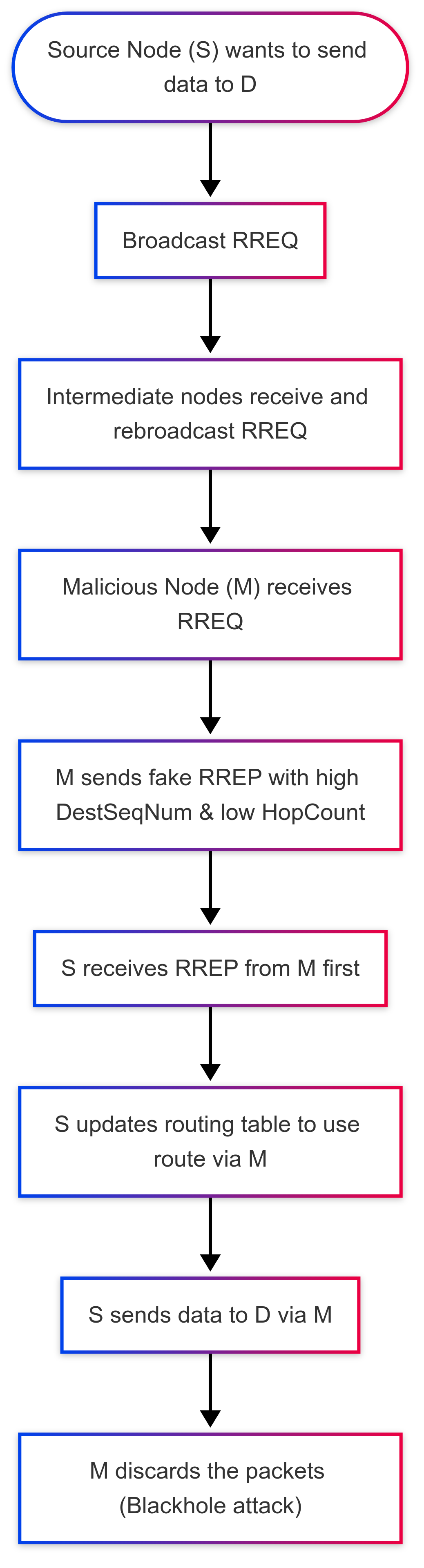
Many reactive routing protocols used in ad-hoc networks, such as the AODV protocol, are primary targets. Let's consider AODV as a prominent example. When a source node (S) wants to send data to a destination node (D) and does not have a route, it broadcasts a Route Request (RREQ) packet. This RREQ propagates through the network. Intermediate nodes that receive the RREQ create a reverse route to S and, if they don't have a route to D, rebroadcast the RREQ.
When the RREQ reaches D, or an intermediate node that has a "fresh enough" route to D, that node generates a Route Reply (RREP) packet. The RREP is unicast back along the reverse path established by the RREQ. AODV uses destination sequence numbers to ensure loop-freedom and to select the freshest routes. A higher sequence number indicates a more recent (fresher) route. If sequence numbers are equal, the route with the smaller hop count is preferred.
A blackhole attacker (M) exploits this:
- M receives an RREQ from S intended for D.
- M immediately fabricates an RREP packet without actually having a valid route to D or being D itself.
- In this false RREP, M typically includes:
- A very high destination sequence number: This makes its advertised route appear extremely fresh, often much fresher than any legitimate RREP that might arrive later from D or other intermediate nodes.
- A very low hop count (e.g., 1 or 2): This makes its advertised route appear to be the shortest path. The RREP packet's structure might look something like this, where certain fields are manipulated by the attacker:
- Because this malicious RREP is often generated immediately and claims superior metrics, it is likely to reach S before any legitimate RREPs.
- S, following the AODV protocol rules, updates its routing table to use the path through M for sending data to D.
- All subsequent data packets from S to D are routed to M, which then discards them.
Dynamic Source Routing (DSR) is another protocol vulnerable. In DSR, the RREQ accumulates the path taken. An attacker can similarly forge an RREP with a seemingly short and valid path that includes itself, causing traffic to be directed its way for subsequent dropping.
6.1.2. False Route Advertisement
Beyond just reacting to RREQs, a malicious node might proactively advertise false routing information. This is more common in proactive routing protocols (table-driven protocols) where nodes periodically exchange routing table updates. A compromised router could broadcast updates claiming reachability to certain networks with excellent metrics, thereby poisoning the routing tables of its neighbors and attracting traffic, which it then drops. Even in AODV, a malicious node might send unsolicited (gratuitous) RREPs to advertise false routes, although this is less standard behavior for AODV and might be more easily flagged as anomalous.
6.1.3. The Cooperative Blackhole Attack (Multiple Attackers)
A more sophisticated and harder-to-detect variant is the cooperative blackhole attack, also known as a coordinated blackhole attack. In this scenario, two or more malicious nodes collude. For example, one malicious node (M1) might advertise a route to a destination, but instead of claiming to be the destination or directly connected to it, it claims a route through a second malicious node (M2). M1 forwards the packets to M2, and M2 is the one that actually drops the packets. This can make detection harder because M1 appears to be forwarding packets correctly (at least to M2). This collusion can create more complex deceptive paths and may even be used to bypass some detection mechanisms that focus on individual misbehaving nodes. Detection of cooperative attacks often requires analyzing broader network behavior or trust relationships between nodes.
6.2. Detecting the Invisible: Identification Strategies
Detecting blackhole attacks is challenging because the malicious node often appears, from a routing protocol perspective, to be behaving legitimately initially, and the packet dropping is silent. However, several strategies have been developed.
6.2.1. Traffic Monitoring and Anomaly Detection
A fundamental approach is to monitor network traffic for anomalies. If a node consistently receives packets but is never observed forwarding them (or forwards significantly fewer packets than it receives for transit purposes), it could be suspected as a blackhole. This often involves nodes operating in a promiscuous mode to overhear the transmissions of their neighbors. Statistical analysis can be applied to packet flow data (e.g., input packet count vs. output packet count for transit traffic at a node) to identify significant discrepancies. Machine learning techniques are increasingly being used to build models of normal network behavior and flag deviations that might indicate a blackhole or other attacks. One recent study highlights an IDS that integrates anomaly detection (using statistical methods and ML) with signature-based techniques, employing adaptive learning to improve detection over time.
6.2.2. Proactive vs. Reactive Detection Mechanisms
Detection mechanisms can be broadly categorized as proactive or reactive.
- Proactive mechanisms attempt to identify malicious nodes before data traffic is routed through them or very early in the process. This might involve sending probe packets along newly established routes to check their validity or requiring nodes to provide cryptographic proof of their claims.
- Reactive mechanisms detect blackholes after they have started dropping packets, often by noticing the failure of data delivery. For example, if a source node sends data but does not receive expected acknowledgments (e.g., TCP ACKs or application-layer ACKs), it might suspect a problem on the path. The challenge then is to pinpoint the location of the blackhole.
A simple reactive method involves a source node, upon suspecting a blackhole, sending a request to its next-hop neighbor, and then that neighbor's next-hop, to confirm if the packet reached the destination.
6.2.3. Sequence Number Analysis (e.g., in AODV)
In protocols like AODV, the destination sequence number in RREP messages is a key indicator. A legitimate RREP usually has a destination sequence number that is current or slightly incremented from the last known sequence number for that destination. If a node consistently offers RREPs with exceptionally high sequence numbers (far beyond what is plausible for normal network operation), it could be flagged as suspicious. Some detection schemes maintain a threshold for acceptable sequence numbers, and RREPs exceeding this threshold are further scrutinized or discarded. For instance, a proposed mitigation for AODV involves checking if the sequence number in an RREP is significantly higher than what's stored in the receiving node's cache for that destination, and if so, initiating a further verification step.
Here's a conceptual pseudocode snippet illustrating where a node might process an AODV RREP and where a blackhole might exploit it:
function process_RREP(packet RREP, node currentNode):
  // Attacker (RREP.source_addr) provides a RREP with a
  // manipulated (e.g., excessively high) destination sequence number
  // or the same sequence number but a suspiciously low hop count.

  current_route_info = currentNode.routing_table[RREP.dest_addr]

  // Standard AODV logic that attacker exploits:
  is_fresher_route = RREP.dest_seq_num > current_route_info.seq_num
  is_same_freshness_shorter_path = (RREP.dest_seq_num == current_route_info.seq_num AND \
                                  RREP.hop_count < current_route_info.hop_count)

  if is_fresher_route OR is_same_freshness_shorter_path:
    // Update route to go through the sender of RREP (the attacker)
    currentNode.routing_table[RREP.dest_addr].next_hop = RREP.source_addr
    currentNode.routing_table[RREP.dest_addr].hop_count = RREP.hop_count
    currentNode.routing_table[RREP.dest_addr].seq_num = RREP.dest_seq_num
    // Subsequent packets to RREP.dest_addr will now be sent to the attacker
    print(f"Node {currentNode.id}: Route to {RREP.dest_addr} updated via {RREP.source_addr}")
  else:
    discard(RREP) // RREP does not offer a better route
    print(f"Node {currentNode.id}: RREP from {RREP.source_addr} for {RREP.dest_addr} discarded.")

// Example of a simple check (could be part of an enhanced protocol):
// if RREP.dest_seq_num > (current_route_info.seq_num + REASONABLE_SEQ_INCREMENT_THRESHOLD):
//    initiate_further_verification_protocol(RREP.source_addr, RREP.dest_addr)
//    return // Do not update route immediately
6.2.4. Cryptographic Approaches and Trust-Based Systems
Cryptographic techniques offer stronger guarantees. Secure routing protocols (discussed below) often use digital signatures to authenticate routing messages, preventing attackers from forging them or modifying critical fields like sequence numbers or hop counts.
Trust-based and reputation systems maintain trust values for nodes based on their past behavior. If a node is consistently involved in paths that fail, its trust level decreases. Future routing decisions can then favor paths through more trustworthy nodes. These systems require mechanisms for nodes to share reputation information reliably and securely, guarding against false accusations or praise. Some approaches use acknowledgement-based schemes where intermediate or destination nodes send back acknowledgements for received packets. The absence of such acknowledgements can pinpoint a misbehaving segment.
6.3. Building Defenses: Prevention and Mitigation
Effective defense against blackhole attacks requires a multi-layered approach, combining preventative measures with robust detection and response capabilities.
6.3.1. Secure Routing Protocols (e.g., SAODV, ARAN)
One of the most effective preventative measures is to use secure routing protocols. Several have been proposed as enhancements to existing ones:
- Secure AODV (SAODV): Extends AODV by using digital signatures to authenticate the non-mutable fields of RREQ and RREP messages (like destination sequence number) and hash chains to secure the hop count. This prevents malicious nodes from arbitrarily fabricating these critical values. Only the destination node can generate an RREP for its own address with a new sequence number.
- Authenticated Routing for Ad hoc Networks (ARAN): Requires nodes to use cryptographic certificates to authenticate themselves and sign routing messages. This ensures that a node claiming a route is indeed who it says it is and that the message hasn't been tampered with. While effective, these protocols often introduce computational overhead due to cryptographic operations, which can be a concern for resource-constrained devices.
6.3.2. Intrusion Detection and Prevention Systems (IDPS)
Intrusion Detection Systems (IDS) specifically designed or configured to identify blackhole attack patterns are crucial. These systems monitor network traffic and node behavior, looking for signatures of known attacks or anomalies that deviate from normal patterns. An Intrusion Prevention System (IPS) can then take automated actions, such as isolating the malicious node from the network or reconfiguring routes to avoid it. As mentioned, hybrid IDSs combining signature-based and anomaly-based detection (often using ML) are becoming more common.
A conceptual Python snippet for a watchdog mechanism, which is a common IDS technique in MANETs:
# Conceptual Watchdog Snippet
class NetworkNode:
    def __init__(self, node_id):
        self.id = node_id
        self.neighbors = {} # neighbor_id: NeighborInfo
        self.packets_sent_via_neighbor = {} # (neighbor_id, packet_id_or_hash): True
        self.packets_overheard_forwarded_by_neighbor = {} # (neighbor_id, packet_id_or_hash): True
        self.suspicion_level = {} # neighbor_id: level

    def send_packet_to_neighbor_for_forwarding(self, packet_content, ultimate_destination, next_hop_neighbor_id):
        print(f"Node {self.id}: Sending packet for {ultimate_destination} via neighbor {next_hop_neighbor_id}")
        # Simulate sending packet to next_hop_neighbor_id
        # Record that this packet was sent via this neighbor
        packet_identifier = hash(packet_content + str(ultimate_destination)) # Simplified packet ID
        self.packets_sent_via_neighbor[(next_hop_neighbor_id, packet_identifier)] = True

        # In a real system, the neighbor would physically receive and process this.
        # For this example, we'll assume the neighbor gets it.

    def overhear_transmission(self, transmitting_node_id, forwarded_packet_content, forwarded_ultimate_destination):
        # This node is in promiscuous mode and overhears a neighbor forwarding a packet
        packet_identifier = hash(forwarded_packet_content + str(forwarded_ultimate_destination))
        if transmitting_node_id in self.neighbors: # Only care about neighbors' forwarding
             print(f"Node {self.id}: Overheard neighbor {transmitting_node_id} forwarding packet for {forwarded_ultimate_destination}")
             self.packets_overheard_forwarded_by_neighbor[(transmitting_node_id, packet_identifier)] = True

    def run_watchdog_check(self, drop_threshold_count=5, observation_window_size=20):
        print(f"\nNode {self.id}: Running watchdog check...")
        for neighbor_id in self.neighbors:
            packets_entrusted_to_neighbor = 0
            packets_confirmed_forwarded = 0

            for (nid, pid), _ in self.packets_sent_via_neighbor.items():
                if nid == neighbor_id:
                    packets_entrusted_to_neighbor += 1
                    if self.packets_overheard_forwarded_by_neighbor.get((nid, pid), False):
                        packets_confirmed_forwarded += 1

            if packets_entrusted_to_neighbor >= observation_window_size: # Only assess if enough data
                dropped_count = packets_entrusted_to_neighbor - packets_confirmed_forwarded
                if dropped_count > drop_threshold_count:
                    self.suspicion_level[neighbor_id] = self.suspicion_level.get(neighbor_id, 0) + 1
                    print(f"ALERT Node {self.id}: Neighbor {neighbor_id} is suspicious! Entrusted: {packets_entrusted_to_neighbor}, Confirmed Forwarded: {packets_confirmed_forwarded}, Sus Lvl: {self.suspicion_level[neighbor_id]}")
                else:
                    # Optionally decrease suspicion level if behavior is good
                    if self.suspicion_level.get(neighbor_id, 0) > 0:
                       self.suspicion_level[neighbor_id] -=1
                       print(f"Node {self.id}: Neighbor {neighbor_id} appears normal. Sus Lvl: {self.suspicion_level[neighbor_id]}")

            # Clean up old packet records to avoid memory bloat (simplistic cleanup)
            # In a real system, time-based windowing or sequence numbers would be better
            keys_to_delete_sent = [k for k in self.packets_sent_via_neighbor if k[0] == neighbor_id]
            # for k_sent in keys_to_delete_sent[:len(keys_to_delete_sent)//2]: # Delete oldest half
            #    del self.packets_sent_via_neighbor[k_sent]
            # keys_to_delete_overheard = [k for k in self.packets_overheard_forwarded_by_neighbor if k[0] == neighbor_id]
            # for k_overheard in keys_to_delete_overheard[:len(keys_to_delete_overheard)//2]:
            #    del self.packets_overheard_forwarded_by_neighbor[k_overheard]


# Example Usage (Conceptual):
# nodeA = NetworkNode("A")
# nodeB_blackhole = NetworkNode("B_blackhole") # This is our attacker
# nodeC_legit_neighbor_of_A = NetworkNode("C_legit")
# nodeD_destination = NetworkNode("D")

# nodeA.neighbors[nodeB_blackhole.id] = {"info": "Neighbor B"}
# nodeA.neighbors[nodeC_legit_neighbor_of_A.id] = {"info": "Neighbor C"}
# nodeB_blackhole.neighbors[nodeA.id] = {"info": "Neighbor A"} # Blackhole has neighbors too

# for i in range(10): # Node A sends 10 packets via B
#    packet = f"data_packet_{i}"
#    nodeA.send_packet_to_neighbor_for_forwarding(packet, nodeD_destination.id, nodeB_blackhole.id)
    # nodeB_blackhole would receive it but NOT forward it. So nodeA won't overhear B forwarding.

# for i in range(10): # Node A sends 10 packets via C
#    packet = f"data_packet_c_{i}"
#    nodeA.send_packet_to_neighbor_for_forwarding(packet, nodeD_destination.id, nodeC_legit_neighbor_of_A.id)
#    nodeC_legit_neighbor_of_A.send_packet_to_neighbor_for_forwarding(packet, nodeD_destination.id, "some_next_hop_for_C") # C forwards
#    nodeA.overhear_transmission(nodeC_legit_neighbor_of_A.id, packet, nodeD_destination.id) # A overhears C forwarding

# nodeA.run_watchdog_check(drop_threshold_count=3, observation_window_size=5)
6.3.3. Redundancy and Multipath Routing
Multipath routing protocols allow data to be sent from a source to a destination over multiple paths simultaneously or in quick succession. This enhances reliability; even if one path is compromised by a blackhole, data can still reach the destination via alternative paths. While it increases overhead, the resilience gained can be critical for important communications.
6.3.4. Ingress and Egress Filtering
In traditional IP networks, ingress filtering (e.g., BCP38, RFC 2827) helps prevent DoS attacks that use spoofed IP addresses. While not directly stopping an internal blackhole node that uses its legitimate address to advertise false routes, maintaining good network hygiene with filtering can limit an attacker's ability to inject certain types of malicious traffic or spoof replies. Egress filtering, checking traffic leaving a network, can also sometimes help identify compromised internal hosts that are part of an attack. In the context of routing, ensuring that route advertisements are only accepted from legitimate and expected peers is a form of filtering.
6.3.5. Honeypots and Deception Technology
Honeypots are decoy systems designed to lure attackers. In the context of blackhole attacks, a honeypot could advertise itself as an attractive target or a vulnerable router. When an attacker attempts to blackhole traffic destined for the honeypot or tries to use the honeypot in its deceptive routing, its malicious behavior can be identified and analyzed in a controlled environment. This can provide early warnings and signatures for updating IDS/IPS.
Successfully countering blackhole attacks requires a defense-in-depth strategy. No single solution is foolproof, but a combination of secure protocols, vigilant monitoring, intelligent detection, and rapid response mechanisms can significantly reduce the risk and impact of these silent saboteurs.
Conclusion
Blackhole attacks, in their deceptive simplicity, represent a persistent and damaging threat to network integrity, particularly in decentralized and resource-constrained environments. By understanding what they are, why they are launched, who the actors are, where they thrive, when they occur, and critically, how they operate and can be foiled, we arm ourselves with the knowledge to build more resilient and secure networks.
We've seen that the core of a blackhole attack lies in the malicious manipulation of routing information, tricking legitimate nodes into sending their data into a void. The motivations are primarily disruptive, aiming for denial of service, with consequences ranging from data loss and resource depletion to complete network partitioning. These attacks are especially potent in MANETs, WSNs, and the burgeoning IoT landscape, but no network relying on trust-based routing is entirely immune. The battle involves attackers seeking to exploit protocol weaknesses, and defenders - network administrators, protocol designers, and security researchers - working to fortify these systems.
The journey from identifying a suspicious RREP in an AODV stream with an impossibly high sequence number to deploying sophisticated, multi-layered defense strategies involving secure protocols like SAODV, intelligent IDPS, and multipath routing underscores the continuous cat-and-mouse game in cybersecurity. While attackers will always seek vulnerabilities, the ongoing development of secure protocols, advanced detection algorithms (increasingly powered by AI), and robust network architectures offers a strong countermeasure.
The silent sabotage of the blackhole need not go unchallenged. Through diligent design, continuous monitoring, the implementation of secure practices, and ongoing education about these threats, its impact can be significantly curtailed. This ensures that our data's journey across complex networks remains safe and reliable. As networks continue to evolve, bringing new paradigms and complexities, the foundational principles of securing data in transit and verifying trust - lessons hard-learned from combating threats like the blackhole attack - will remain paramount in safeguarding our digital interactions.
What's Your Reaction?