[QuickNet] - P3 - Route Summarization
Route summarization is a crucial technique in network design that helps reduce the size of routing tables by aggregating multiple IP addresses into a single address with a broader subnet mask. This process simplifies routing decisions, enhances performance, and conserves bandwidth. In this blog post, we will delve into the steps involved in route summarization, particularly when dealing with routes of different subnet masks.

Steps to Perform Route Summarization
-
Identify the Network Ranges:
- Determine the specific network addresses and their respective subnet masks that you intend to summarize.
-
Convert Addresses to Binary:
- Convert each network address into its binary form. This conversion will help in identifying the common bits among the addresses.
-
Find the Common Bits:
- Compare the binary representations of the addresses to find the longest sequence of common bits starting from the leftmost bit. These common bits form the basis of your summary address.
-
Determine the Summary Address:
- The summary address is derived from the common bits. This portion of the address remains unchanged, while the remaining bits are set to zero.
-
Calculate the Subnet Mask:
- Count the number of common bits identified in the previous step. This count will determine the subnet mask for the summary address.
-
Verify the Summary:
- Ensure that the calculated summary address and subnet mask encompass all the specific routes intended for summarization without including unintended addresses.
-
Implement the Summary Address:
- Configure the routing protocol on your router to use the newly calculated summary address and subnet mask.
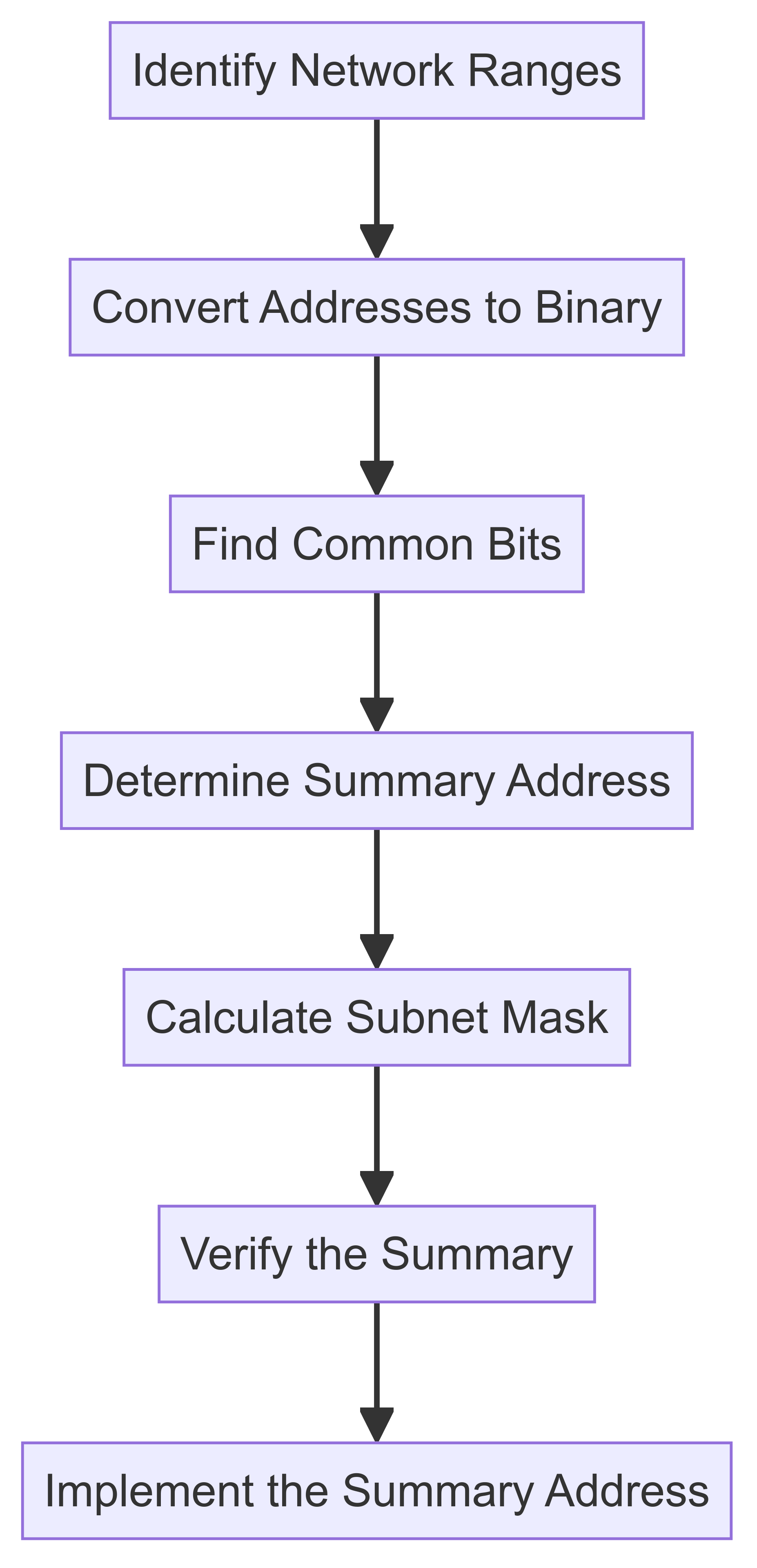
Flowchart for Route Summarization Process
Here is a flowchart that outlines the steps involved in the route summarization process:
Example: Summarizing Routes with Different Subnet Masks
Let’s consider an example where we need to summarize the following routes with different subnet masks:
- 192.168.10.0/23
- 192.168.12.0/24
- 192.168.13.0/25
- 192.168.13.128/26
Step-by-Step Calculation
-
Convert to Binary:
- 192.168.10.0/23:
11000000.10101000.00001010.00000000 - 192.168.12.0/24:
11000000.10101000.00001100.00000000 - 192.168.13.0/25:
11000000.10101000.00001101.00000000 - 192.168.13.128/26:
11000000.10101000.00001101.10000000
- 192.168.10.0/23:
-
Identify Common Bits:
- The binary representations reveal the common bits:
11000000.10101000.0000
- The binary representations reveal the common bits:
-
Summary Address:
- The common bits translate to the summary address: 192.168.8.0
-
Calculate Subnet Mask:
- There are 20 common bits, hence the subnet mask is 255.255.240.0
-
Verify the Summary:
- The summary address 192.168.8.0/20 covers the address range from 192.168.8.0 to 192.168.15.255, which includes all the given routes.
Implementing the Summary Address
To implement the summary address in your routing protocol configuration, you would add the following command to your router configuration:
router eigrp 100
network 192.168.8.0 0.0.15.255
This command configures EIGRP (Enhanced Interior Gateway Routing Protocol) to summarize the specified routes into a single summary route.
Advantages of Route Summarization
-
Reduced Routing Table Size:
- Summarization reduces the number of entries in the routing table, leading to faster routing decisions and improved router performance.
-
Enhanced Network Stability:
- By limiting the number of routes advertised, summarization can minimize the impact of network changes, such as link flaps, on the overall network.
-
Improved Bandwidth Utilization:
- Fewer routing updates are transmitted across the network, conserving bandwidth and reducing processing overhead.
-
Simplified Network Management:
- A summarized route provides a high-level view of the network, making it easier to manage and troubleshoot.
Disadvantages of Route Summarization
-
Loss of Specific Route Information:
- Summarization can lead to a loss of detailed route information, which might be necessary for certain network policies or troubleshooting.
-
Potential for Suboptimal Routing:
- If the summarized address encompasses more routes than intended, it may lead to suboptimal routing and increased latency.
-
Complex Configuration:
- Properly configuring and verifying summarization requires a thorough understanding of the network topology and careful planning.
Key Considerations for Route Summarization
-
Accurate Network Addressing:
- Ensure that the summarized address accurately reflects the intended network ranges and does not include unintended addresses.
-
Routing Protocol Compatibility:
- Verify that the chosen routing protocol supports summarization and that the configuration is compatible with other routers in the network.
-
Impact on Network Performance:
- Monitor network performance after implementing summarization to ensure that it positively impacts routing efficiency and does not introduce issues.
-
Redundancy and Failover:
- Plan for redundancy and failover scenarios to ensure that route summarization does not adversely affect network availability.
Conclusion
Route summarization is a powerful technique that improves the efficiency and scalability of networks. By understanding and applying the steps outlined above, network administrators can effectively manage routing tables and optimize network performance. Whether dealing with routes of identical or varying subnet masks, the principles of summarization remain consistent, allowing for streamlined and efficient routing processes. However, it is essential to consider the advantages, disadvantages, and key factors to ensure successful implementation of route summarization in your network.
Could you answer this question?
Which address and mask combination represents a summary of the routes learned by EIGRP? (The answer is at the end)
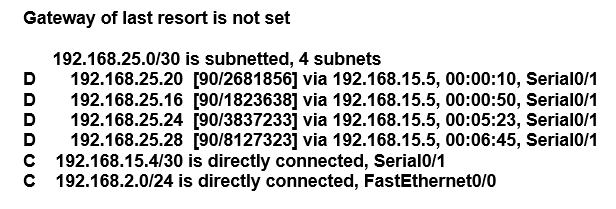
A. 192.168.25.0 255.255.255.240
B. 192.168.25.0 255.255.255.252
C. 192.168.25.16 255.255.255.240
D. 192.168.25.16 255.255.255.252
E. 192.168.25.28 255.255.255.240
F. 192.168.25.28 255.255.255.252
-----------------------------------------------------------------
[QuickNet] - P2 - How to Determine if Two IP Addresses Belong to the Same Subnet
[QuickNet] - P1 - Firewalls: A Castle Gatekeeper
Answer: C. 192.168.25.16 255.255.255.240
What's Your Reaction?